Life in extremes
Ecological and evolutionary genomics
Deserts are bellwethers for climate change and are outstanding natural laboratories to study biological adaptation. Since the start of my PhD research, we have sought to advance our general understanding of the genetic basis and evolutionary mechanisms underlying mammalian adaptation to extreme arid and hyper-arid environments. To address this, we use a set of integrative approaches to study the demographic and adaptive history of North-African foxes and other desert-dwelling species.
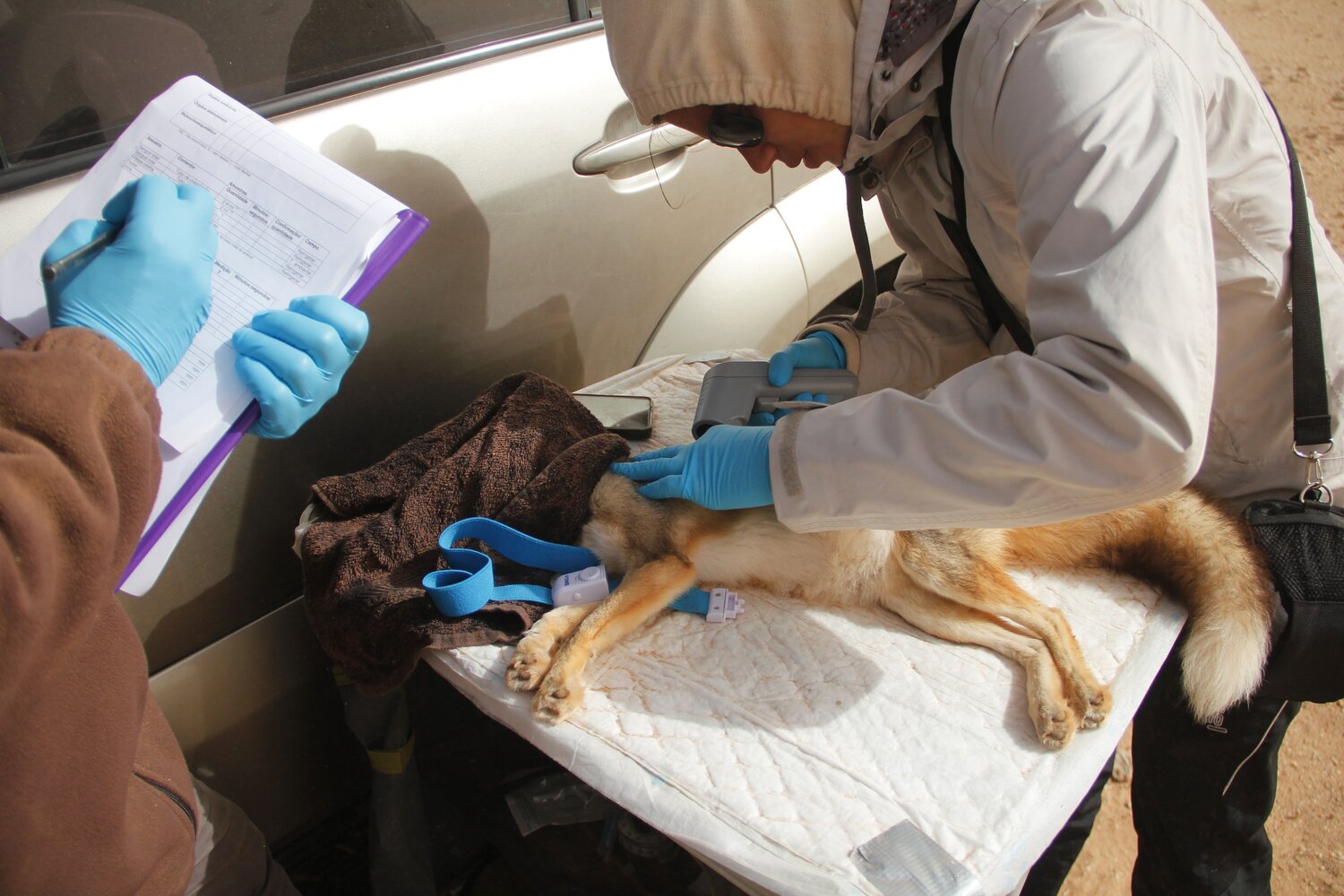
Left: check-up and blood collection. Right: a curious Rüppell's fox inspecting a cage-trap at night.
Representative publications on this topic include:
- Joana L. Rocha, José C. Brito, Rasmus Nielsen, and Raquel Godinho (2021). Convergent evolution of increased urine-concentrating ability in desert mammals. Mammal Review. 10.1111/mam.12244
- Joana L. Rocha, Raquel Godinho, José C. Brito, and Rasmus Nielsen (2021). Life in deserts: the genetic basis of mammalian desert adaptation. Trends in Ecology & Evolution. 10.1016/j.tree.2021.03.007
- Joana L. Rocha, Pedro Silva, Nuno Santos, et al. (2023). North-African fox genomes show signatures of repeated introgression and adaptation to life in deserts. Nature Ecology & Evolution. 10.1038/s41559-023-02094-w
Media highlights:
- Searching for adaptation secrets in the Sahara Desert — QB3-Berkeley, by Diana Aguilar-Gómez
- These rare adaptations help animals survive in the desert — Discover Magazine, by Jason P. Dinh
- Handling the heat: how foxes have adapted to a warming climate — Berkeley Science Review, by Samvardhini Sridharan

Designs by Madeleine Snyder.